
Introduction
Digital marketing tips for small businesses can help you build a strong online presence, attract the right audience, and generate more customers without spending a huge marketing budget.
Running a small business is already a full-time job. You have products to manage, customers to serve, employees to coordinate, and sales targets to meet. Marketing can easily become another thing on a long to-do list.
However, customers are increasingly discovering businesses online before deciding where to buy.
Whether someone searches for a nearby service, checks Instagram before making a purchase, reads Google reviews, or visits a company’s website, your online presence can influence their decision.
The good news is that small businesses do not need to compete with large companies on every platform.
Instead, the goal should be to reach the right people with the right message at the right time.
A smart digital marketing strategy combines several channels. SEO can help you appear in organic search results. Social media can help you build relationships. Google Ads can help you reach people with high purchase intent. A good website can turn that traffic into enquiries or sales.
Google also recommends keeping a Business Profile complete and accurate because this can help businesses appear in relevant local searches. Local ranking is primarily influenced by factors such as relevance, distance, and prominence.
So, instead of trying every marketing trend at once, start with the fundamentals.
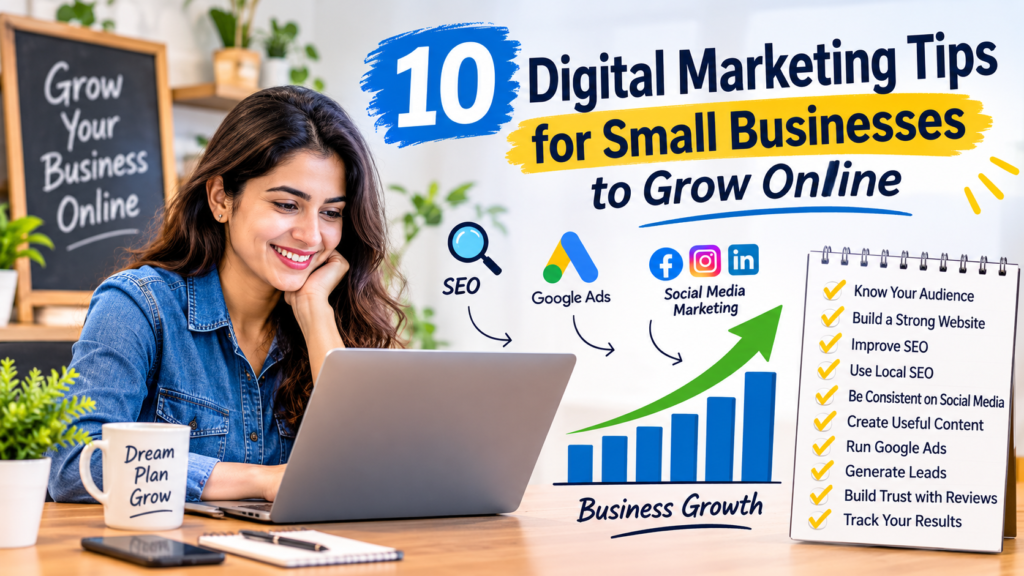
Here are 10 practical digital marketing tips for small businesses that can help you build a stronger online presence.
Digital marketing tips for small businesses can help business owners make smarter marketing decisions and reach potential customers online.
1. Understand Your Target Audience
One of the biggest mistakes small businesses make is trying to market to everyone.
If you try to reach everyone, your message often becomes too general.
Before spending money on advertising or creating dozens of social media posts, understand exactly who you want to attract.
Define your ideal customer
Think about:
- Age group
- Location
- Profession
- Income level
- Interests
- Problems
- Buying habits
- Preferred platforms
- Common objections
- Reason for purchasing
For example, imagine you run a local fitness studio.
Instead of targeting:
“People interested in fitness”
you could target:
“Working professionals in Jaipur who want convenient evening fitness classes.”
The second audience is much more specific.
That makes it easier to create relevant content, advertisements, offers, and landing pages.
Find your customer’s real problems
Your marketing should answer questions customers actually have.
For example:
- How much does the service cost?
- How long does it take?
- Is the business trustworthy?
- Does the business serve my area?
- What makes this product different?
- Can I see customer reviews?
- How do I book or order?
These questions can become your content ideas.
Expert tip: Talk to existing customers. Ask them why they purchased from you, what almost stopped them from buying, and what they searched for before contacting you.
That information can be more useful than guessing what your audience wants.
2. Build a Professional Website
Your website is often the foundation of your online presence.
Social media platforms are useful, but your website gives you much more control over your brand, information, customer journey, and conversion process.
A small-business website does not need hundreds of pages.
It needs to be clear, trustworthy, fast, and easy to use.
Essential website pages
Depending on your business, consider including:
- Home
- About Us
- Services or Products
- Portfolio
- Testimonials
- Blog
- Contact
- FAQ
For local businesses, clearly display:
- Business name
- Location
- Phone number
- Opening hours
- Service areas
- Directions
- Contact options
Make your homepage answer three questions
A visitor should quickly understand:
What do you offer?
Who do you help?
What should I do next?
For example:
“Affordable Website Design for Small Businesses”
followed by:
“Get a professional, mobile-friendly website designed to help your business generate more enquiries.”
Then add a clear CTA:
Get a Free Consultation
This is more effective than simply writing:
“Welcome to our website.”
Don’t forget mobile users
Many potential customers will visit your website using a smartphone.
Check your website on:
- Mobile
- Tablet
- Desktop
Make sure buttons are easy to tap, text is readable, images load properly, and important information isn’t buried.
3. Focus on SEO
SEO, or Search Engine Optimization, helps your website become easier for search engines and users to understand.
For small businesses, SEO can be particularly useful because it can bring consistent organic traffic without requiring you to pay for every click.
However, SEO is not simply about adding keywords repeatedly.
Good SEO starts with understanding search intent.
Following the right digital marketing tips for small businesses can improve website visibility and attract relevant organic traffic.
Use keywords naturally
Suppose you are a website designer in Jaipur.
Potential keywords might include:
- website designer in Jaipur
- website design services
- WordPress website designer
- website development services
- affordable website design
- business website design
Instead of putting all these keywords into one paragraph, create useful pages around specific topics.
For example:
Service page:
Website Design Services in Jaipur
Blog:
How Much Does a Business Website Cost?
Blog:
5 Things to Check Before Hiring a Website Designer
Simple SEO tips
- Use a descriptive page title.
- Write useful meta descriptions.
- Use one clear H1 heading.
- Organize content with H2 and H3 headings.
- Add descriptive image alt text.
- Link related pages internally.
- Improve page speed.
- Make pages mobile-friendly.
- Create useful content around customer questions.
- Keep business information consistent.
The most important rule is simple:
Write for people first and search engines second.
Google’s guidance emphasizes creating helpful, reliable, people-first content rather than producing content primarily to manipulate search rankings.
4. Use Local SEO to Reach Nearby Customers
If your business serves a particular city or area, local SEO should be part of your digital marketing strategy.
Imagine someone searches:
“digital marketing agency near me”
or
“best salon in Jaipur”
Your business needs strong local signals to have a chance of appearing for relevant searches.
Create and optimize your Google Business Profile
For eligible businesses, Google Business Profile can help customers discover the business on Google Search and Maps. Google recommends keeping business information complete and accurate.
Add accurate information such as:
- Business name
- Primary category
- Address
- Phone number
- Website
- Opening hours
- Services
- Photos
- Business description
Google specifically recommends choosing the most appropriate primary category rather than using categories simply as keywords.
Encourage genuine reviews
Reviews can help potential customers understand what it’s like to work with your business.
After completing a successful project or purchase, politely ask customers for honest feedback.
Then respond to reviews professionally.
Do not buy fake reviews or encourage customers to post misleading feedback.
Google notes that responding to reviews can demonstrate that you value customer feedback.
Build local relevance
You can also create content around your service area.
For example:
- Web Design Services in Jaipur
- Best Marketing Ideas for Jaipur Restaurants
- SEO Tips for Local Businesses
- How Jaipur Businesses Can Generate More Leads Online
This helps connect your content with real local customer needs.
5. Be Consistent With Social Media Marketing
One of the most practical digital marketing tips for small businesses is to focus on platforms where their target customers are active.
You do not need to be active on every social media platform.
That is one of the most common small business marketing mistakes.
Instead, choose platforms based on where your customers actually spend time.
For example:
| Business Type | Potentially Useful Platforms |
| Fashion Brand | Instagram, Facebook, Pinterest |
| B2B Consultant | |
| Local Restaurant | Instagram, Facebook, Google |
| Coaching Business | Instagram, YouTube, LinkedIn |
| E-commerce Brand | Instagram, Facebook, Pinterest |
| Local Service Business | Instagram, Facebook, Google |
Follow the 3-part content approach
A useful social media strategy can include:
Educational content
Teach your audience something.
Examples:
- SEO tips
- Marketing mistakes
- Product tutorials
- How-to videos
Trust-building content
Show why people should believe your business.
Examples:
- Client testimonials
- Case studies
- Behind-the-scenes content
- Team introductions
- Before-and-after results
Promotional content
Tell people what you sell.
Examples:
- New service
- Product launch
- Special offer
- Consultation
- Booking availability
The mistake is posting only promotional content.
People don’t want every post to feel like an advertisement.
6. Create Useful Content
Content marketing is one of the most practical ways to build authority over time.
Instead of constantly saying:
“Buy from us.”
create content that helps customers make better decisions.
Answer customer questions
Suppose you own a digital marketing agency.
Instead of writing only:
“We offer SEO services.”
you could publish:
- What is SEO?
- How long does SEO take?
- How much does SEO cost?
- SEO vs Google Ads: Which is better?
- 10 SEO tips for small businesses
- How to choose an SEO agency
These topics can attract people who are actively researching a problem.
Some readers may eventually become customers.
Repurpose one idea
You don’t need to create completely new content every day.
One blog post can become:
- Instagram carousel
- Short video
- LinkedIn post
- Facebook post
- Pinterest graphic
- FAQ section
For example:
Blog:
“10 SEO Tips for Small Businesses”
can become:
Instagram:
“5 SEO mistakes small businesses should avoid”
LinkedIn:
“Why small businesses should invest in SEO”
Short video:
“3 SEO fixes you can make today”
This approach saves time and keeps your messaging consistent.
7. Use Google Ads With a Clear Goal
SEO can take time.
If you need faster visibility for specific high-intent searches, Google Ads can be useful when managed carefully.
Google Ads allows businesses to reach people searching for relevant products or services.
However, paying for traffic does not automatically create sales.
Your entire customer journey matters.
These digital marketing tips for small businesses can help owners use their advertising budget more effectively.
Before launching an ad
Define:
Goal → Audience → Keyword → Ad → Landing Page → Conversion
For example:
Goal: Generate website design enquiries
Keyword: website designer in Jaipur
Ad: Professional Website Design for Small Businesses
Landing page: Website Design Services
CTA: Book a Free Consultation
Don’t send every ad to your homepage
A dedicated landing page can be more relevant.
If your ad promotes SEO services, the landing page should immediately explain your SEO service rather than making visitors search through your homepage.
Track conversions
Depending on your business, conversions might include:
- Phone calls
- Form submissions
- WhatsApp enquiries
- Bookings
- Purchases
- Newsletter sign-ups
Google also provides options for advertising businesses through Google Maps and other Google properties, although eligibility and campaign features vary.
Expert tip: Start with a small, controlled campaign. Test your keywords, ads, audience, and landing page before increasing your budget.
8. Build a Simple Lead Generation System
Getting website visitors is not enough.
You need a way to turn interested visitors into leads.
This is where lead generation becomes important.
A lead could be someone who:
- Fills out a contact form
- Calls your business
- Sends a WhatsApp message
- Books a consultation
- Requests a quote
- Signs up for an email list
Create one clear CTA
Don’t overwhelm visitors with ten different actions.
Choose the action that matters most.
For example:
Get a Free Quote
or
Book a Consultation
or
Order Now
Make your form simple
A small business usually doesn’t need a 15-field form.
Start with:
- Name
- Email or phone
- Service required
- Short message
You can collect more information later.
Respond quickly
Lead generation doesn’t end when someone fills out your form.
The next step is follow-up.
A simple system could be:
New enquiry → Immediate acknowledgement → Personal follow-up → Consultation → Proposal → Follow-up → Sale
A good marketing campaign can generate leads, but your sales process determines how many of those leads become customers.
9. Use Reviews and Social Proof
Trust matters.
Before buying from an unfamiliar business, customers often want evidence that other people had a good experience.
That evidence is called social proof.
Examples include:
- Google reviews
- Testimonials
- Case studies
- Client logos
- Before-and-after results
- User-generated content
- Product ratings
Create stronger testimonials
Instead of:
“Great service!”
a stronger testimonial explains:
“We needed a new website for our local business. The new website made it easier for customers to understand our services and contact us.”
Specific testimonials are more useful because they explain the customer’s problem and experience.
Create case studies
A simple case study can follow this format:
Problem:
What was the customer struggling with?
Solution:
What did you do?
Result:
What changed?
Lesson:
What can another customer learn from this?
Do not exaggerate results.
If you claim a specific percentage increase, make sure you can support the claim with real business data.
That approach supports credibility and stronger EEAT signals.
10. Track Your Results and Improve
One of the biggest advantages of digital marketing is that you can measure performance.
You don’t have to guess whether something is working.
Track important metrics based on your business goals.
Website metrics
Look at:
- Website visitors
- Traffic sources
- Top landing pages
- Engagement
- Conversion rate
- Contact form submissions
SEO metrics
Monitor:
- Search impressions
- Clicks
- Search rankings
- Organic traffic
- Organic conversions
- Pages generating traffic
Social media metrics
Track:
- Reach
- Engagement
- Saves
- Shares
- Profile visits
- Website clicks
- Leads
Advertising metrics
Monitor:
- Impressions
- Clicks
- Cost per click
- Conversion rate
- Cost per lead
- Return on ad spend
The important point is not to chase every metric.
Focus on numbers connected to your business goals.
For example, 10,000 social media views may look impressive, but 20 qualified enquiries may be more valuable to a service business.
Digital Marketing Strategy: Organic vs Paid Marketing
Small businesses often wonder whether they should focus on SEO or paid advertising.
The answer depends on your goals, budget, industry, competition, and timeline.
| Factor | Organic Marketing | Paid Marketing |
| Main channels | SEO, content, social media | Google Ads, paid social |
| Cost model | Time and resources | Pay for advertising |
| Speed | Usually slower | Usually faster |
| Long-term value | Can compound over time | Stops when campaigns stop |
| Testing | Requires patience | Faster testing |
| Best for | Long-term visibility | Immediate targeted traffic |
| Main challenge | Takes time | Requires ongoing budget |
For many businesses, the strongest approach is not choosing one over the other.
Use paid campaigns for immediate opportunities while building organic assets such as SEO content, reviews, email lists, and social proof.
10 Digital Marketing Tips at a Glance
If you want a simple checklist, start here:
- Understand your target audience.
- Build a professional, mobile-friendly website.
- Use SEO to improve organic visibility.
- Optimize your Google Business Profile for local search.
- Stay consistent with social media marketing.
- Create useful, customer-focused content.
- Use Google Ads strategically.
- Build a simple lead generation system.
- Collect genuine reviews and testimonials.
- Track results and improve continuously.
Expert Tips for Small Businesses
1. Start with one clear goal
Don’t try to increase followers, traffic, sales, leads, and awareness at the same time.
Choose a priority.
For example:
“Our main goal for the next 90 days is to generate 30 qualified enquiries per month.”
That makes your marketing easier to measure.
2. Own your customer data
Build assets you control.
Your website and email list are valuable because you aren’t completely dependent on an algorithm.
Social platforms can change their reach or features at any time.
3. Focus on high-intent searches
A keyword with fewer searches can sometimes be more valuable than a broad keyword.
For example:
“digital marketing”
is broad.
“digital marketing agency for small businesses in Jaipur”
shows much clearer intent.
Look for relevance, not just search volume.
4. Make your marketing local when appropriate
If you serve a particular city, mention your service area naturally across relevant website content, your Business Profile, and customer-facing information.
Don’t create dozens of nearly identical city pages simply to target keywords.
Google’s Business Profile guidance emphasizes accurate business representation and appropriate categories rather than keyword stuffing.
5. Test before scaling
Don’t immediately increase your advertising budget because one campaign received clicks.
First determine whether those clicks produce meaningful actions.
Traffic is useful.
Qualified traffic is better.
Customers are the real goal.
Common Digital Marketing Mistakes
Mistake 1: Trying every platform
You don’t need to be everywhere.
Choose the platforms where your audience is most active.
Mistake 2: Posting without a strategy
Posting every day does not guarantee growth.
Each piece of content should have a purpose.
Mistake 3: Keyword stuffing
Repeating the same keyword unnaturally can make content difficult to read.
Use related phrases naturally.
Mistake 4: Ignoring local SEO
If you serve a specific area, don’t overlook Google Business Profile, local pages, reviews, and accurate business information.
Mistake 5: Sending paid traffic to a weak website
Ads cannot fix a confusing landing page.
If visitors cannot quickly understand your offer, they may leave.
Mistake 6: Buying fake reviews
Fake reviews can damage trust and may violate platform policies.
Focus on genuine customer experiences.
Mistake 7: Not following up with leads
Generating a lead is only the beginning.
Have a process for responding and following up.
Mistake 8: Measuring vanity metrics
Followers and likes can be useful, but they aren’t always tied directly to revenue.
Track metrics that matter to your business.
Frequently Asked Questions
1. What are the best digital marketing tips for small businesses?
The most important steps are understanding your target audience, building a professional website, investing in SEO, using local SEO, maintaining consistent social media marketing, creating helpful content, using paid advertising strategically, generating leads, collecting reviews, and tracking results.
2. How can a small business start digital marketing with a low budget?
Start with the basics. Create a professional website, optimize your Google Business Profile if eligible, publish useful content, collect genuine reviews, and maintain one or two social media channels. Once these foundations are working, test paid advertising with a controlled budget.
3. Is SEO better than Google Ads for a small business?
Neither is universally better. SEO can support long-term organic visibility, while Google Ads can provide faster access to targeted searches. Many businesses benefit from using both as part of a broader digital marketing strategy.
4. How important is local SEO for small businesses?
Local SEO can be very important for businesses that serve specific locations. A complete and accurate Google Business Profile can help eligible businesses appear on Google Search and Maps for relevant local searches.
5. How often should a small business post on social media?
There is no universal number that works for every business. Consistency and quality are more important than posting simply to meet a daily target. Start with a manageable schedule and increase it only if you can maintain quality.
6. What type of content should small businesses create?
Start with content that answers customer questions. Tutorials, FAQs, comparisons, case studies, checklists, industry tips, customer stories, and product or service demonstrations are useful starting points.
7. How can small businesses generate more leads online?
Create clear calls to action, use simple contact forms, offer useful resources, optimize service pages, use local SEO, run targeted advertising, and follow up quickly with enquiries.
8. How long does digital marketing take to show results?
It depends on the channel. Paid advertising can generate traffic quickly, while SEO and content marketing generally require more time to build visibility. Results also depend on competition, website quality, budget, industry, and execution.
9. Should every small business have a Google Business Profile?
Not every business is eligible. Google says Business Profiles are designed for eligible businesses that interact with customers in person, including businesses with physical locations or certain service-area businesses.
10. What is the most important digital marketing strategy for a small business?
There is no single strategy that works for every business. The strongest starting point is usually a clear target audience, a trustworthy website, relevant SEO, a focused content strategy, a strong conversion process, and measurement.
Implementing these digital marketing tips for small businesses consistently can support long-term online growth.
Conclusion
Digital marketing does not have to be complicated for small businesses.
You don’t need to be active on every social platform, publish content every day, or spend a huge amount on advertising.
What you need is a clear strategy.
Start by understanding your customers. Build a website that answers their questions. Use SEO to improve your organic visibility. If you serve a local area, optimize your local presence. Create useful content, build trust through genuine reviews, and use Google Ads when paid traffic makes business sense.
Most importantly, measure what happens after someone discovers your business.
A click is not the final goal.
A follower is not the final goal.
A website visitor is not the final goal.